|
Introducing the “Certified” Precedence |
|
– James Wades, WB8SIW
In an ideal world, the National Traffic System would have sufficient volunteers to facilitate message originations and deliveries at most locations throughout the United States and Canada.
However, this is not always the case.
Routine radiograms often propagate through the system with minimal delay only to reach their destination Section where some are held for days awaiting an “outlet” in the form of a volunteer reasonably close to the addressee who can perform the delivery function.
This situation points to two often conflicting imperatives within the NTS, one of which is the need to keep nets active with sufficient traffic to incentivize volunteer participation, and the other of which is the customer service requirement for timely and accurate delivery of routine radiograms.
On one hand, we do not want to starve Section and local nets of traffic, but on the other hand, we do not want routine radiograms to sit for days until someone near the addressee checks into a net.
The solution to this problem is a new “certified” precedence. A certified radiogram is a routine radiogram that prioritizes customer service in the form of timely and accurate delivery above that of ensuring a message reaches a point as close to its last mile destination as possible.
This new precedence recognizes that NTS is in the customer service business.
Simply put, in our modern telecommunications environment, those originating unique personal radiograms deserve a positive experience in which their message reaches the addressee in a timely manner.
The certified precedence may not be used for “bulk” messages that often contain a common text, and which are addressed to individuals with whom the originator has no prior relationship.
These latter types of messages are not typically time-sensitive and often have incorrect contact information harvested from out-of-date online sources. While properly managed bulk originations can prove beneficial by establishing relationships between the local amateur radio community and an addressee, they must retain the “routine” precedence, and the goal is to push them through the network to a point as close as possible to the “last mile.”
As a general guideline, a “certified” precedence radiogram “expires” 48 hours after its time of origination.
Upon expiration, it must be delivered to the addressee regardless of its location within the National Traffic System.
Furthermore, there are specific requirements for use of the “certified” precedence. For example:
-
The originator shall have a reasonable expectation that the address, phone number and other contact information contained in the radiogram address has been verified as both timely and correct before origination (in other words, address data cannot be harvested from online directories or the like).
-
The message transmitted must be unique in character.
-
The message shall be transmitted only as the result of a prior direct relationship or transaction between the originator (signatory) and addressee.
In other words, a holiday greeting sent to one’s family member would be classified as “certified,” whereas a “please renew your ham radio license” radiogram sent to a stranger must use the routine precedence.
When originating a “certified” radiogram, the time of origin (in UTC) must be included. This starts the clock ticking down to the 48-hour expiration deadline.
On a related note, in order to ensure accurate and professional-grade management of certified and higher precedence traffic, Radio Relay International has established the “Certified Radio Operator” training program to not just support certified precedence message traffic, but also to ensure that sufficient expertise is available within the traffic community to manage welfare, priority and emergency precedence messages.
More about the certified precedence, as well as the Certified Radio Operator program, can be found on the Radio Relay International website.
|
|
Updating the ARL Numbered Radiograms |
|
For many years, ARRL has promulgated a list of “ARL Numbered Radiogram Texts” through which a lengthy phrase or message text could be transmitted as a numerical code.
For example, “ARL FORTY SIX” would be delivered as “Greetings on your birthday and best wishes for many more to come,” or “ARL ONE” would be delivered as “Everyone safe here, please don’t worry.” These numerical codes preserve circuit capacity and contribute to overall network efficiency.
Radio Relay International and the NTS2.0 Committee have now released a more extensive, updated list of ARL Numbered Radiogram Texts.
This new list is backwards compatible with the older list, which had remained unchanged for many decades.
However, the updated version contains a variety of new ARL Numbered Radiogram Texts designed to better support the “I Am Safe” program and emergency communications operations.
The latest approved list can be found under the “Publications” heading on the Radio Relay International website at https://radiorelay.org/files/reference/ARL_Numbered_Radiogram_Texts.pdf and on the NTS2 website at: https://nts2.arrl.org/numbered-texts/.
All NTS volunteers are encouraged to print out and retain the new list.
|

|
|
|
Section Traffic Manager Meeting |
|
A virtual meeting of Section Traffic Managers from throughout the country was called on October 9 by ARRL Field Services Manager Mike Walters, W8ZY. Section Managers were also invited to attend.
There were approximately 40 in attendance. This was a first opportunity in recent memory for STMs to gather to share common problems, activities and goals, etc.
Thanks to Mike, W8ZY, for arranging this meeting.
There was a lot of discussion on topics such as the need for recruiting new traffic handlers, the need for NTS and ARES to work together to develop training, and a need for regular testing of the network for reliability and accuracy.
There was a discussion on the use of the “welcome to amateur radio” type messages as a great introduction for new licensees to the hobby, including opportunities for club participation and training in message handling.
Those present seemed appreciative of this opportunity and expressed interest in future meetings, perhaps on a quarterly basis.
A group has been set up on groups.io and invitations were sent out to all STMs listed on the ARRL database.
Comments about topics for future meetings are requested and may be posted on this website.
|
|
– Dan Rinaman, AC8NP
Hello, Treasure Hunters!
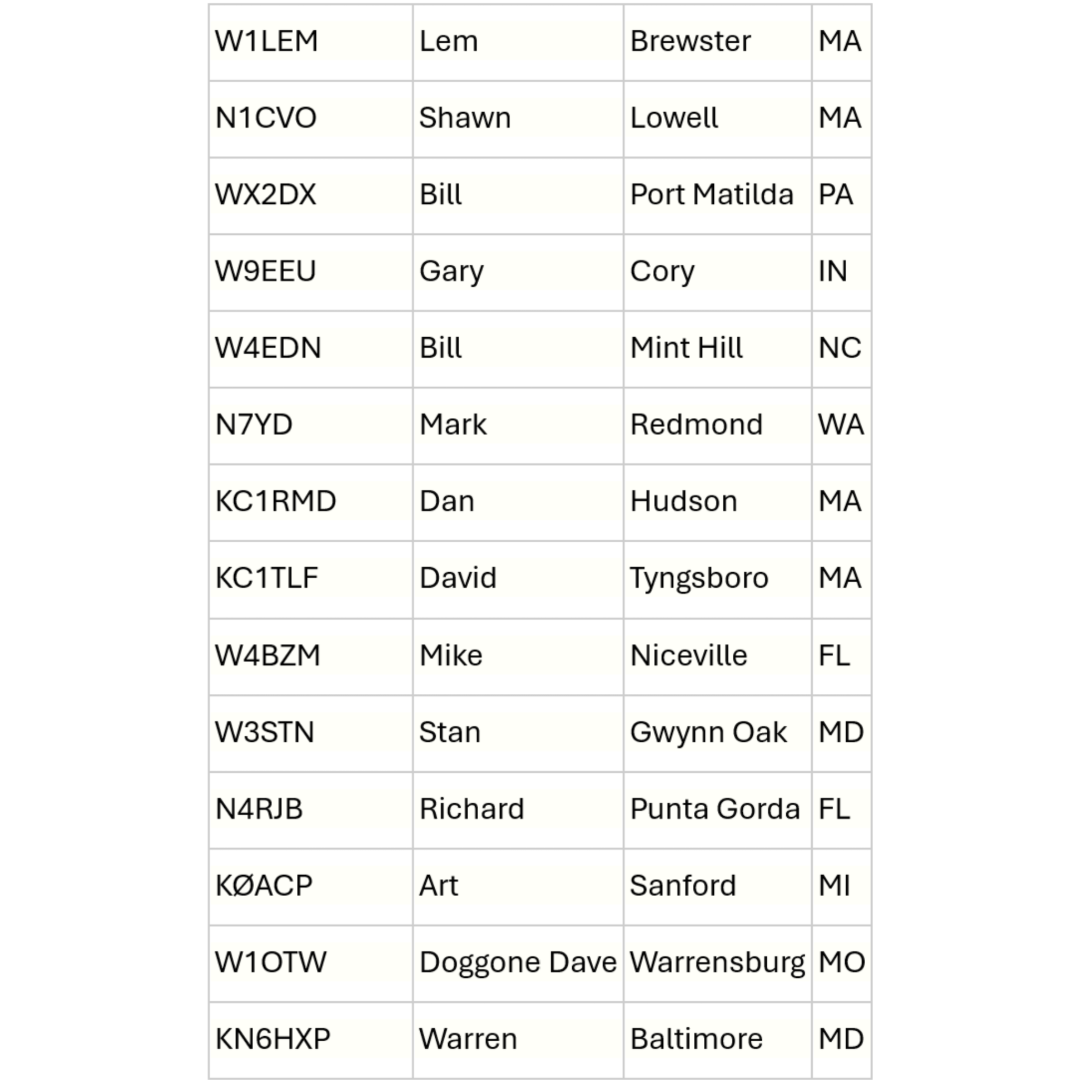
Fifteen stations completed all six rounds in the September 2025 NTS Treasure Hunt.
|
 |
|
|
Mug Award Winner for September is Bill Heybruck, W4EDN
In previous Treasure Hunts, a special mug was awarded to the first hunter to finish the hunt. We received feedback that sometimes radiograms are inexplicably delayed, and a hunter may end up not finishing first despite their diligence on the hunt. Starting with the November 2024 hunt, the mug has been awarded with a random drawing from all hunters who complete the hunt.
There were a few problems which were discovered and remedied this past hunt. The Winlink radiograms got stuck in the system due to some confusion as to where DTN stations were to pick up traffic. This has been fixed.
We still seem to be having problems with getting confirmations (HXC) back from our messages. If you deliver a message to the addressee of a message with HXC, whether on air or any other means, you need to send a message such as an ARL FORTY SEVEN to the originating station.
September Questions
THR1 WHAT IS THE MEANING
OF THE Q SIGNAL QNQ
QUERY REPLY TO GLENN
VE1AQF METEGHAN NS B0W 2J0
Answer “Move frequency to ____ and wait for _____ to finish handling traffic. Then send him traffic for _____. This can be found in the FSD-218.
THR2 WHICH ERROR FREE DIGITAL
MODE IS USED FOR LONG
DISTANCE RELAYS BETWEEN REGIONS QUERY
REPLY TO JAY NK2Y LAGRANGEVILLE
NY 12540
Answer “PACTOR”
THR3 YOU RECEIVE A RADIOGRAM
WITH A CHECK OF 15/17
X WHAT DOES THIS MEAN
QUERY REPLY TO JON N1ILZ
EASTHAM MA 02642
Answer: “Check was corrected from 15 to 17”
THR4 HOW SHOULD FIGURES BE
VOICED WITHIN MIXED GROUPS QUERY
REPLY TO RAY KB8GUN LAURELVILLE
OH 43135
Answer: in MPG section 2.1.5.6
Example "THR2 would be voiced as Tango Hotel Romeo 2, not Tango Hotel Romeo figure 2"
THR5 WHICH EVENT PROMPTED THE
UNIVERSAL USE OF SOS AS
A DISTRESS CALL QUERY REPLY
TO MICHELLE K2MJR POUGHKEEPSIE NY
12603
Answer: “The sinking of the Titanic/Titanic disaster”
THR6 WHICH COUNTRY MUSIC STAR
CHANGED HIS CALLSIGN TO W4CGP
REPLY TO DAN AC8NP TIFFIN
44883
Answer: Chet Atkins. I did not realize the current holder of W4CGP is also a musician. He looks like he is accomplished but maybe not quite a star.
On to the November Treasure Hunt
This hunt will have 4 or 5 rounds. Can you get through all the rounds by Christmas, December 25th?
For those of you who have trouble finding a net into the NTS, you are free to use the Radiogram Portal.
So here is the first-round question:
NR 1 R HXG AC8NP 26 TIFFIN OH NOV 2
TREASURE HUNTERS
BT
THR1 WHAT IS THE NAME
AND CALLSIGN OF A WELL
KNOWN GUITARIST FROM BEVERLY
HILLS 90210 QUERY REPLY TO
GLENN VE1AQF METEGHAN NS B0W
2J0
BT
DAN AC8NP
Canada’s postal codes are alphanumeric in this pattern ANA NAN. (Note on DTN there is no space between the two character groups.)
Please remember to start your message with the THR1-5 answer, which means Treasure Hunt Round Number.
The judges will usually respond with a radiogram back to you within 24 hours of the receipt of your message (at times, they may miss a day due to family or illness). Our judges are on traffic nets almost daily. The in-transit time will vary. So, if it has been 4 or 5 days and you do not receive a reply radiogram, try sending an email message to the judge.
Try to learn about the NTS in your Section. Who is your Section Traffic Manager (STM)? The STM can answer your questions on how to move traffic in and out of your section.
If you missed the official Treasure Hunt announcement in the December 2023 issue of The NTS Letter, here is a recap: This is a fun, on-air, multi-step competition in which you will respond to a "judge" with your answer to an initial clue or question via radiogram. The judge will reply via radiogram with the identity of the next judge, along with the next question or clue in the hunt.
If you have any comments or suggestions, please email Dan Rinaman, AC8NP, at ac8np@ac8np.com.
|

|
|
|
Traffic Tips: Handling Instructions |
|
In the September 2025 issue of The NTS Letter, I wrote under “Traffic Tips” about the use of handling instructions, seen as HX in the preamble of a radiogram.
These instructions are optionally added by the originator of a message for reasons they consider important, and for which they have the expectation that these instructions will be carried out.
(A list of handling instructions is available on the ARRL website as well as the NTS2 and RRI websites.) You read previously in this issue about the “certified precedence” and its differences from other routine messages.
It is especially important that handling instructions on these messages be carried out if the amateur radio messaging service is to be taken seriously, something I am sure we all desire.
If a message is not delivered it is important for the system to discover the reason so that any problems can be rectified.
A method available is use of the HXD handling instruction which reads, “Report to originating station the identity of station from which received, plus date and time.
Report identity of station to which relayed, plus date and time, or if delivered report date, time and method of delivery.” This is mandatory for anyone handling that message.
A convenient radiogram response is use of the numbered radiogram “ARL NINETY FOUR” which reads, “Received your message ____ (number) for ____ (addressee) from _____ (station) _____ on _____ (date) _____ (time). Relayed / delivered to _____ (station) on _____ (date) _____ (time) via _____ (net/method).” (This numbered text was formerly assigned to ARL 41 which had apparently been reserved for future use of welfare texts.) In this case one need only fill in the blanks after sending “ARL NINETY FOUR”. For example:
ARL NINETY FOUR 124 BOB JONES W0ABC OCTOBER 26 2035 X RELAYED K1DEF OCT 26 2110 SECTION NET
All the required information for tracking is there and in a form a tracking station can easily follow.
As this message crossed time zones it is important that UTC time was used.
Check in preamble is ARL 18.
Note: Radio Relay International is discontinuing use of RRC in favor of all radiograms using ARL notation for numbered texts.
|
|
Questions have been asked from time to time about how to find traffic nets. Information on the ARRL website is often out of date. Nets may have moved to other frequencies, often have incorrect contact information, and sometimes are no longer in existence. As reported in the past, there is an ongoing effort to correct this situation, but for various reasons progress has been slow. Meanwhile, more up-to-date information on traffic nets can be found on the Radio Relay International website. Go to https://radiorelay.org/publications/ and look for the Publications tab. Net managers are encouraged to check accuracy for their nets. As noted on the site, all additions, deletions or changes should be sent to n2nov@nyc-arecs.org
or via HXE radiogram.
|
|
The Importance of Messages |
|
– Denny Rybicke, K9LGU, STM Wisconsin
FAQ # 290: Are the messages we hear on our nets important? Sure, they are. Some might question the value of the messages we relay.
It seems to them that the information we transfer isn't of high importance, so why do we bother? Couldn't we just call the recipient with our cell phone? Well, that's the point. We do it for the times that the cell phone isn't working.
When we pass someone and say, "hello," "good morning," or "hot enough for you?" we aren't really exchanging much information — but it's important to say those greetings to recognize the other person, to be polite, to test the system.
Before any significant, sizable meeting — such as a national convention, a large congregation's church service, or a sold-out rock concert — some sound technician walks up to a microphone and says something like, "Testing. One, two, three..." Those words certainly don't carry important information, but it is extremely important that they be said.
If they're not, how will the technician know if the system is functioning properly? So it is with our nets.
We run them to exercise the system — including our equipment, our knowledge, and our skills.
Exercises such as the Simulated Emergency Test, Field Day, a public service event, or daily traffic nets are valuable because of the training they provide.
When we test equipment, procedures or ourselves, it makes us a better team for doing what we do.
Is the content of all of our messages of high importance? Sometimes, maybe not.
Is it important that we use those messages for practice? Always.
|
|
Traffic Handling Training In Southern New Jersey |
|
– Dave Sheppard, W2PAX, SNJ & SFL STM
Traffic handling in the Southern New Jersey Section has fallen off in the last several years.
In cooperation with Section Manager Ron Fish, KX1W, a two-part virtual training class was held on October 7 and 14. The first segment was an introduction to and overview of the National Traffic System, with the second segment getting into the basic parts and composition of a radiogram.
With over two dozen amateurs present, the sessions proved valuable with an active Q&A at the end of each session.
Said SM Fish, “Our goal is to build a traffic handling base and initiate local net(s) for the Section.”
A post-training survey indicates an interest in more in-depth training in the SNJ section.
SM Fish and STM Sheppard will be coordinating through the fall about what the next steps are, with a goal of early 2026 to roll out additional training.
They are also looking for suitable local repeater systems to establish local level traffic nets.
In the meantime, attendees were encouraged to join the NTS Virtual Training Net, as well as monitor NJ statewide HF nets to get a feel for how traffic nets should operate.
We are looking forward to getting the NTS active in the SNJ Section in 2026.
|
|
Spotlight – Glenn Killam, VE1AQF |
|
First, a little background.
My earliest interest in radio came about when I received a crystal radio kit for Christmas when I was perhaps 6 or so. Being able to pick up our local low-power AM station and listen through headphones was like magic to my 6-year-old self. In our kitchen was an old Philco floor model radio and I used to listen to the Voice of America, BBC, Radio Canada International and, of course, Radio Moscow.
Then I discovered these weird sounding signals that were like high-speed whooshing sounds.
When I asked a friend of dad's, Clyde, VE1DW (SK), what they were, he said they were Morse code.
He invited me into his shack above his radio repair shop and I was enthralled.
A couple of years later when I joined Cub Scouts, one of the things I learned was Morse code.
I think I was perhaps 12 or so when I joined the local radio club and I got to actually operate under the supervision of one of the local hams, CW of course.
After leaving high school in 1960, I took a course in electronics at the vocational school where one of the projects was construction of a huge rack-mounted transmitter. That was a real learning experience.
After graduating from the electronics class, I decided I would join the RCAF.
Because of my excessive height, I was deemed too tall for flight school so they assigned me to ground communications.
I had already received extensive training in electronics, so a lot of the theory was repetitive.
The best part was the daily CW classes, spent with cans on listening to cipher groups from old prewar RCA receivers.
I got to the point where I could copy 40+ WPM and transcribe onto a mill with essentially 2 or 3 fingers (I never did learn to touch type and still can't).
After leaving the service, I bounced around for a year or so and then decided to move to Ontario where I renewed my interest in radio.
During my bounce-around times, I had acquired my amateur radio license and one of my first purchases when I got to Ontario was a Knight T-60 transmitter and a Trio receiver.
During a trip to Boston to visit a friend, I had an eyeball with Roger Dodds, W1CMW (SK), with whom I had been communicating regularly on 80-meter CW. He gave me a WWII bug to learn how to operate, although for many years it sat unused as I was not sure how to use it.
Then I met my future wife and radio activities became secondary.
We got married, raised one daughter, lost another daughter and moved several times.
During this time, I did not spend a lot of time on CW.
In 2000, Industry Canada decided to do some cost-cutting and made all amateur licenses permanent.
At the same time, any hams who had not become Advanced class were grandfathered into Advanced with a 12-wpm certificate. I quickly obtained an FT101E and a TS120 as well as being willed an older 2-meter mobile radio by my late brother, whose call sign I now have.
On 2 meters, I discovered several local nets and was introduced to traffic handling by way of doing rally comms and the like.
By this time, I was ready (I thought) to jump into Cycle 4 nets. A very steep learning curve.
After being put down a few times, I decided to study up on procedures and became relatively efficient, just in time for ECN to fold.
For a time, I spent most of my radio time on 75-meter SSB nets, mainly in Michigan and Ohio.
Then I got the chance to take some messages to EAN Cycle 2 and later, Cycle 4. Then a ham in Ohio came up with the idea of creating a website which allowed other hams to download address and phone information for new hams, upgrades and vanity calls.
Kate Hutton, K6HTN, came to me asking if I would be interested in sending out welcome messages to new hams in the west.
Of course I said, “sure.” And the rest is history.
At the present time, my traffic generation covers Regions 1, 2, 5, 6, 7, 9, and 10. In addition, I send welcome messages to new members of CWOPS, a group which was set up with the premise of preserving the use of Morse Code in amateur radio.
I am member #457 of over 3800 at last count. Also, I have twice-weekly CW skeds with DFØNTS in Germany during which messages are swapped.
All the above is in addition to serving as NCS for EAN Cycle 4 (CW) and as a Transcontinental Corps (TCC) operator keeping schedules with both central and western area counterparts.
You may ask how I have so much time to devote to this aspect of the hobby.
As a semi-invalid, a widower and almost an octogenarian, time is all I do have.
Were it not for ham radio, I don't know what I would do with myself.
I do knit occasionally, also do cross-stitch and jigsaw puzzles, but ham radio is my main go-to activity. 73
-- Glenn Killam, VE1IJ / VE1AQF
|
 |
|
|
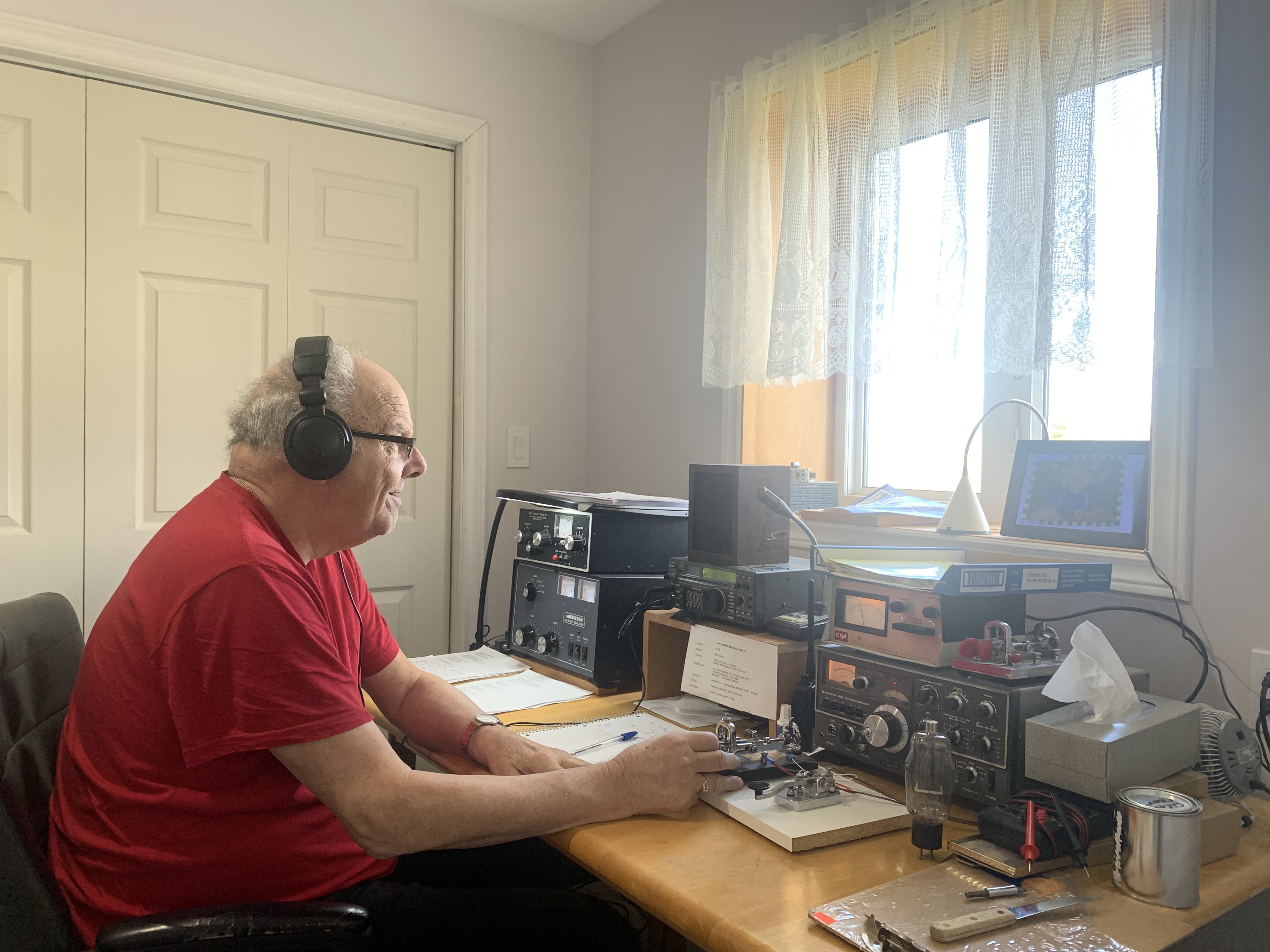
[Glenn Killam, VE1AQF, photo] | | | |
|
The National Traffic System® (NTS®) is a network of amateur radio operators who move information during disasters and other emergencies.
General messages offering well-wishes also move through the NTS® to help test the system and to help amateur radio operators build traffic handling skills.
While the NTS® is primarily set up to serve the United States and Canada, it is possible to move traffic internationally through the NTS® via various local, regional, area, and international network connections.
NTS 2.0
NTS Manual
NTS Methods and Practices Guidelines
Handling Instructions
Numbered Texts
Encoding Rules for Agency Forms
Virtual NTS Training Net
|
|
Sign Up to Receive The NTS Letter |
|
The NTS® Letter is published monthly and is free of charge to ARRL members. Subscribe: www.arrl.org/opt-in-out
If anyone has not received copies of The NTS Letter by email, be sure to check www.arrl.org/opt-in-out
to confirm that you are opted in. If you don't see The NTS Letter listed among the publications you are opted into, click on "Edit," and you will have the opportunity to check the box to receive The NTS Letter. If you have missed any issues, you can find them all at www.nts2.arrl.org/nts-letter-issues
as well as on the ARRL website.
Editor: Marcia Forde, KW1U, Section Traffic Manager -- Eastern Massachusetts, Western Massachusetts, and Rhode Island
ARRL Director of Emergency Management: Josh Johnston, KE5MHV
|
|
NTS® is a program of ARRL The National Association for Amateur Radio®. No other organization works harder than ARRL to promote and protect amateur radio! ARRL members enjoy many benefits and services including digital magazines, e-newsletters, online learning (learn.arrl.org), and technical support.
Membership also supports programs for radio clubs, on-air contests, Logbook of The World®, ARRL Field Day, and the all-volunteer ARRL Field Organization.
|
|
The
NTS Letter is published every month (12 times each year). ARRL members may subscribe at no cost or unsubscribe by editing their Member Data Page at
www.arrl.org/opt-in-out.
Copyright © 2025 American Radio Relay League, Incorporated. Use and distribution of this publication, or any portion thereof, is permitted for non-commercial or educational purposes, with attribution. All other purposes require written permission.
|
|



